Phd january session
Saturday 31 january 2026
FEEDBACK
13:30 - 14:30 UTC
BRAVER SPACES CHECK-IN
AI x FAsCISM, A TALK BY GEOFF COX
TIME TBC
BRAVER SPACES CHECK-IN
phd community management session
led by andrew freiband, phd 2020
Sunday 1 feb 2026
FEEDBACK
18:00 - 20:00 UTC
BRAVER SPACES CHECK-IN
Artistic research outside the academy: reflections on life as an independent artist-researcher, A TALK + WORKSHOP by JO SCOTT.
18:00 - 20:00 UTC
BRAVER SPACES CHECK-IN
student-led session: PROTEST WEAVING WORKSHOP with britta fluevog
phd TALK
AI x Fascism, a talk by Geoff Cox
Publicity still for Charlie Chaplin’s The Great Dictator. (Source: Wikimedia Commons.)
The title employs a popular and deliberately ambiguous connective ‘x’, at once a substitute for ‘and’, ‘loves’, ‘multiplies’, and a reference to the much-maligned social media platform owned by a big-tech billionaire. It signals the complexities involved when seemingly divergent entities are brought together in this way. By pairing AI and fascism, the talk traces historical connections between aesthetics and politics; from Walter Benjamin’s artwork essay, written amid rising fascism in Europe to alt-right meme cultures of the present. When it comes to AI, we might broadly claim that it reproduces fascist-like tendencies as it concentrates power in centralised infrastructures, is founded on extractive logic, and is owned by powerful elites who believe that access to power is their divine right. But AI isn’t inherently fascist, and can it be imagined differently?
SYLLABUS
bio | site
Recording
phd TALK + WORKSHOP
Artistic research outside the academy: reflections on life as an independent artist-researcher, a talk + WORKSHOP by Jo Scott
Image from Jo Scott, ‘Creative Field Work in Forest Plantations: Seeking Resonance in Precarious Landscapes.’
In this talk, Jo Scott reflects on her move from engaging with artistic research as a full-time academic within a university framework to her current positioning as an independent artist-researcher, collaborating with academics, practitioners, third sector and industry.
As part of the talk, Jo reflects on what changes when artistic research is pursued outside university supports and frameworks, raising questions about knowledge production and hierarchies of knowledge as well as practical considerations such as:
Making a living as an independent artist-researcher;
Modes of dissemination and application – different ways your research can be used and applied;
The quasi-academic life – keeping engaged with academic discourses while also connecting to other ways in which knowledge happens in the world;
The value and values of practice research outside the academy;
Ways of creating and occupying more fluid interdisciplinary spaces.
As an independent researcher, I also want to use the talk to explore how we might form new, distributed communities of research that reach outwith the academy, and where we can more freely explore the epistemic conditions required for artistic research to flourish and contribute. As Swati Arora proposes:
‘we need to imagine and build alternate spaces for collective learning and thinking. We gather, assemble, and study together, outside of the gated corridors of the university and create a coalition with those who were left out … This is the clarion call of the present moment’ (2021, P.18).
STUDENT-LED WORKSHOP
PROTEST WEAVING with BRITTA Fluevog
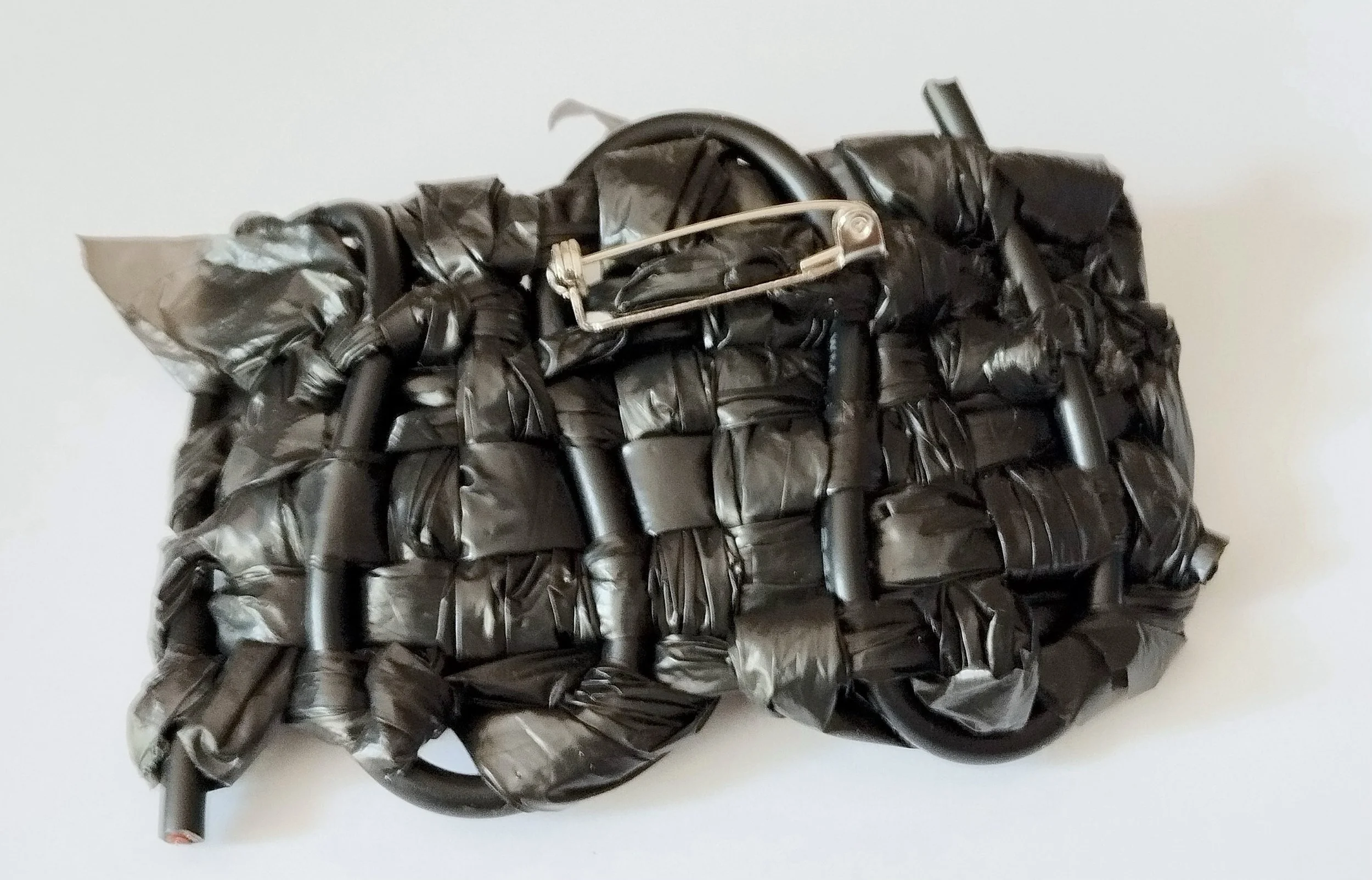
Protest Weaving. Britta Fluevog
I am inviting you to learn about my research by participating in it. I am hosting a hands-on protest pin making workshop that is geared towards Transart Institute students, but is open to any who wishes to attend. I will discuss this project and how it relates to my other research and what methodologies I use, also speaking shortly about ethical approval. As this is a research project, all participants must fill out a consent form, ideally prior to the workshop. Participant Consent Form: Workshop – Fill in form.
The study is trying to determine if workshops can be an effective way to create inclusive and accessible art activism. We are looking for people who would like to be more involved in protest and are interested in learning to weave a pin. The ideal candidate would be interested in protest, but due to any number of reasons, is not able to, or is no longer able to, participate in traditional protests. But everyone 18+ is welcome to join. Participants will learn to weave in an online workshop. Part of the workshop includes answering questionnaires to aid of the research and measure if workshops can be a successful method of inclusive and accessible art activism.
Timeline: The workshop will take 2 hours, with a 10 minute introduction, 1.5 hours of making time interspersed with technical instructions. The last half hour will be spent discussing and writing letters to recipients of the protest pins as well as filling out surveys.
Items required for workshop:
cardboard (the thicker the better) approx. 10 cm (4") x 9 cm (3½")
found material: plastics or other materials to weave with such as ropes, cables, cords, old clothes [garbage is ideal]
scissors
a safety pin or broach/ pin backing
suggested items:
Exacto knife or box cutter (cutting knife) & cutting surface
thick yarn or twine (optional)
a very wide eyed needle, crochet hook, wire made into big eyed needle, paperclip opened almost all way to leave one hook, wire with a hook at the end or small safety pin
ruler/ straight edge
fork or comb
prep work: collect materials
*** We will be cutting a hole in the cardboard approx. 5cm (2") x 4 cm (1½") using a cutting knife. If this is something that you have not done before or are not comfortable with, it is suggested to ask a friend or use a drill or nail to make the holes and use scissors or SIMPLY SKIP THIS STEP. The hole just makes weaving easier.
We will be giving the pins to someone of authority as either an act of protest or a humble request. You may want to give it to the president of the company you work for or a university you attend or a local or regional politician. You can decide ahead of time or during the workshop (or decide to just keep it).
If you know who you think you might want to gift the pin to, you may want to take this into consideration when gathering materials. Using industrial waste materials or garbage from that location is a good idea if possible. Black (if that is a funerary colour in your location) and garbage bags are ideal for this pin to be mailed as an act of environmental protest.
__ __ __
phd community management session
Monthly online gatherings will emphasize the shared (yet often isolating) experience of pursuing research practice while pursuing in a low residency PhD, through productive complaining, accountability checks and transparency. Space will be provided within this framework for low-lift student-led initiatives including localized ‘pop up’ residencies and writing retreats/ social gatherings; visiting scholar invitations; student presentations of research ‘prototypes’; and other student-suggested spinoffs of these community gatherings. Absent any similar models of the forms of research being engaged in at Transart, this programming intends to provide useful support to students through comparative standards setting, allowing each students to see and be seen so that ‘success’ in research and writing can be reasonably framed within the context of a low residency doctoral program.